

"We participate in affiliate programs and may earn a commission from products on this page" Learn More
It’s July 5, 90 degrees, and I’m at the farm to mow my future yard, not to hang cameras. But there’s a Tactacam Reveal Folding Solar Panel riding in the truck that I’d picked up at Tractor Supply three days earlier, my Reveal X Pro that I’ve been running the last few seasons, and the mineral site on the field edge doesn’t have a camera on it yet.
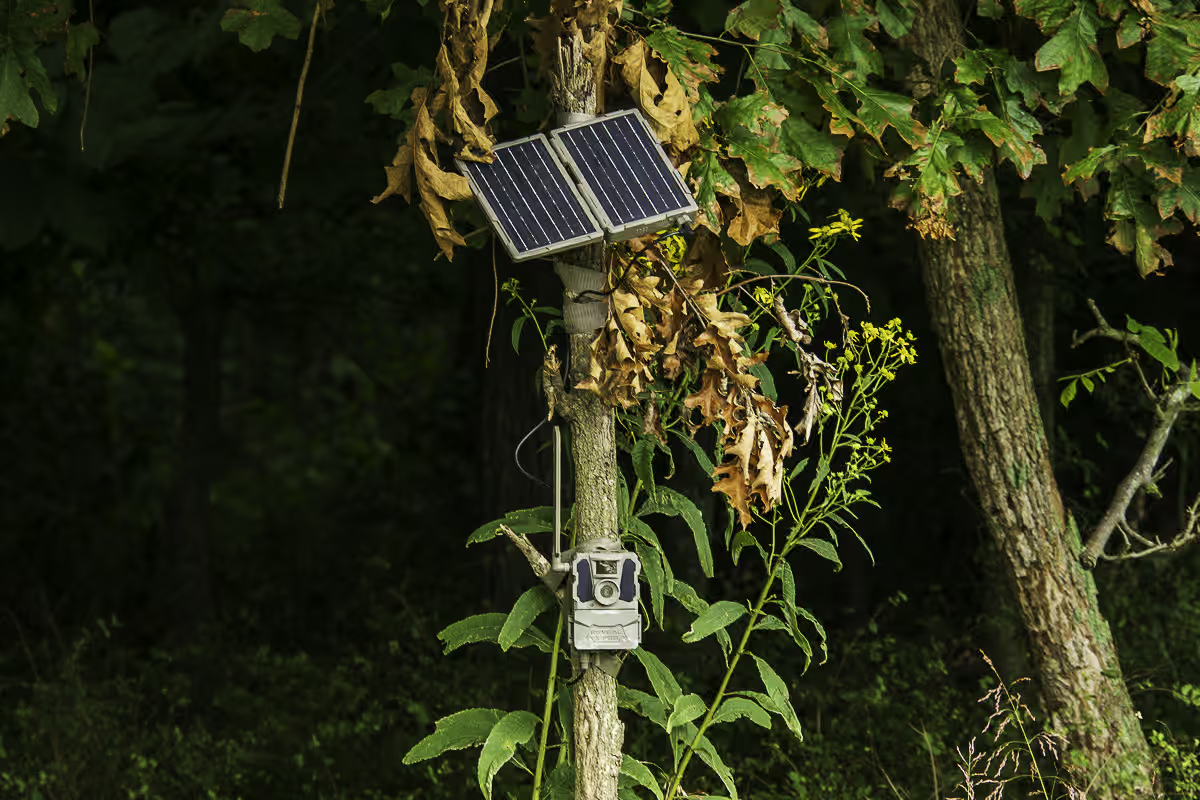
The camera going under the panel was my Reveal X Pro, the one I’ve run since Tactacam released it. I put the bracket on the tree about six feet up, right above the camera, pointed the panel south, cinched the strap, and screwed the DC cable into the camera port. Two or three minutes. Then I went and mowed.
That was 67 days ago, and I haven’t been back to that tree since.
Here’s where it stands as of September 10. The app shows 12,622 photos off that camera in the last 31 days, and the AAs in it still read 100 percent. That’s the whole review if you want the short version. If your camera hangs where the sun can find it, this panel is a no brainer at a hundred bucks. If it hangs under a full canopy, I don’t think the answer is the same, and I’ll get to why.
What you’re buying with the Tactacam Reveal Folding Solar Panel

The two fold out panels are rated at 3.6 watts apiece, or 7.2 watts total, with a 4,900mAh lithium battery built in. The battery feeds the camera through a DC cable into the external power port. You can also pre charge the built in lithium battery with a USB-C charger, which Tactacam says takes four to five hours. It’s rated IPX66 for dust and water, folds to about 8 by 6 inches, and comes with the mounting bracket, a strap, and both cables. The warranty is one year so if for some reason it fails inside that year Tactacam replaces it.
It’s tailored for Reveal cameras and Tactacam claims it’ll even work with most other 12 volt cellular cameras, but keep in mind I only tested it on a Reveal so take the other part from them, not me.
Tactacam is rubbing shoulders with some big claims about this thing: charging 400% faster than their older V2 panel and up to 5,000 photos a day in direct sunlight. Honestly, I cant speak to the first of those since I never ran their V2 to compare. As for the second, we’ll get to that soon.
The battery treadmill this lick had me on
That particular lick has been a personal drain on my AA battery stockpile over the years. When the deer are consistently hitting the lick during the summer and a camera is set up in a nearby tree, snapping away with bursts of 3 shots at max range with night flash, it’d go through a dozen AAs every two weeks. That’s the routine I went through every summer. Swap out a dozen Energizers, make the drive out, trudge to the tree, swap them out, make the drive back home and repeat every other week
Do the math on one camera. Twelve batteries every two weeks from June through August is 72 batteries, or three 24 packs. Depending on where you buy them, that’s somewhere around $45 to $60 a summer, before gas, and before you count the trips themselves. A $100 panel that runs more than one summer pays for itself. This one has already covered most of a summer’s worth of batteries, and it’s sitting there ready for the next one.
One note, since this whole review sits on a mineral site. If your ground is inside Kentucky’s CWD Surveillance Zone, KDFWR’s rules on minerals and bait have changed more than once in the last few years. Check the current CWD Surveillance Zone page before you put a bag out.
How I hung it, and the step I skipped
The way to do this right is charge that internal battery up over a USB-C plug before you put it up in a tree. That’s the one thing I didn’t do. The LEDs were on about half power when I took the thing out of the box & I hung it anyway because by that point I was already out there & the lawn mower was waiting for me. But 67 days later that little time saver hasn’t cost me anything obvious. Still though, charge yours first. A half a battery’s a whole lot less leeway if you put it up right before a wet spell.
Setting up the solar panel was as straight forward as it comes. Bracket straps to the tree and the panel mounts to the bracket. Simple as that. Mine is currently mounted roughly six foot high, directly over my Reveal X Pro, facing south. This is all located on a field edge so there’s almost nothing between the solar panel and the sky. That one detail matters more than you might think. Its also the reason results using solar panels for cameras can vary so much.
The DC cable had plenty of length for a same tree setup, and the connector has a screw collar that locks it into the camera port. Some other models don’t have that, and a plug that backs out a quarter inch in November is a camera that goes dark in November.
67 days of numbers
Here are the settings, because a photo count means nothing without them. Photo mode at 16MP. Three shot bursts two seconds apart with multi shot send on, so all three photos from every trigger come to my phone. Night mode on max range. A 15 second delay. Settings check on Instant and send type on Timely. That’s not a battery saver setup. That’s a camera set to scroll through trail camera photos like your scrolling Facebook.
The app shows 12,622 photos from that camera in the last 31 days. That works out to about 400 photos a day, or somewhere around 135 triggers a day with the bursts. The camera’s AA batteries read 100 percent on September 10, and nothing in 67 days has moved them.
We’ve had a few rainy stretches of a few days each since July, and the reading didn’t change through any of them. Half a charge out of the box plus a few days of clouds is the kind of thing that should show up somewhere. It hasn’t.
Here’s why the AAs never moved, and it’s the part most people miss. The panel doesn’t charge your AAs. Tactacam says it plainly: it’ll charge their Lithium Pack but not AA batteries. What it does is power the camera directly, so the camera never asks the AAs for anything as long as the panel has something to give. Those 12 Energizers are the backup plan, and they haven’t been called on yet.
So what about 5,000 photos a day? I’m running about 400 a day on a busy setup and the panel hasn’t blinked. I can’t tell you what 5,000 would do, because no lick I own is that busy, and I doubt yours is either. What I can tell you is that 400 a day at 16MP, with three shot bursts and max range night flash, is a heavy load, and it hasn’t touched the AAs in 67 days.
What this panel can’t tell me
The Reveal app will show you how the panel itself is holding up, but only on the 3.0 cameras and newer. The panel I’m currently running is setup with an X Pro, which is older, so the only gauge I have is the camera’s own battery reading. If I’d put it on one of my X 3.0s or the Pro 4.0, I’d have a second number for you. I didn’t, and that’s on me. If you own a newer Reveal, you’ll get more information out of this panel than I did.
I also can’t tell you what it does in winter. Every one of my 67 days has been a long summer day with the sun high. December is short days, low sun, and a lithium battery sitting in the cold, and that’s the real test of any solar panel. I’ll update this review after deer season with whatever it does.
Who should buy it and who should skip it
Do you need one of these on every camera you own? No. I run six Reveal cameras and currently own one panel.
Yea, a panel makes a camera easier to live with anywhere. But it earns its $100 in one specific spot: a camera in open terrain or on a field edge where deer stack up in summer and the batteries can’t keep pace. Put it there and it pays for itself in a summer or two of batteries, and you stop making the drive.
If most of your cameras are located in the timber under a heavy canopy with little direct sun, I’d think hard before spending the money. A panel that never sees the sun is mostly a $100 battery pack. Tactacam sells a Lithium Cartridge and a Battery Belt for those spots, and this panel will charge either one, but I can’t speak to how they hold up on their own yet.
The honest answer is that this panel is only as good as the sky above it. Mine has a lot of sky.
Where it stands
If you’re deciding what to hang under one of these, I can honestly say I’ve been pleased with all the Tactacam trail cameras I’ve run so far.
Sixty seven days, 12,622 photos in a month, and I haven’t put a boot track near that lick since July. Put it where the sun hits it and you’ll forget the camera has batteries in it.