

I was 8 or 9 years old, standing in the timber with my dad somewhere between the stand and the truck, and we’d been stopped a lot longer than usual. It was cold. My dad and I had a routine on Kentucky rifle season mornings. When I got restless in the tree we’d climb down and take the long way out. He called it hunting our way back to the truck.
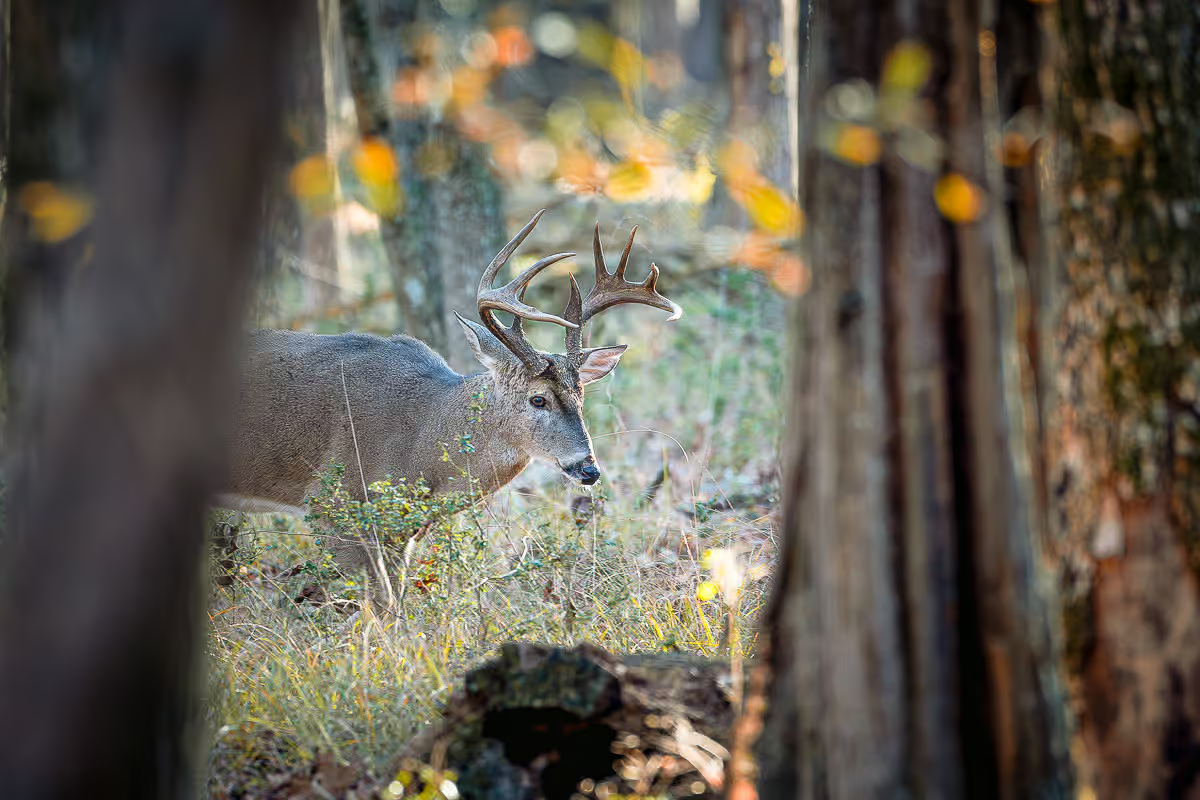
I asked him why we weren’t moving. He said he could hear something ahead of us in the timber but couldn’t see it yet. I couldn’t hear a thing. A minute later a doe stepped into view with a buck behind her that, to a 9 year old, was a world record.
He handed me the rifle and tried to get me steady. I had buck fever so bad I couldn’t hold the crosshairs on him, and the buck pushed the doe off through the timber before I got my composure back.
I asked my dad this year how big that buck was. He’s never scored a deer, but going by how he described him and the wall bucks he compared him to, I’d put him in the 170s.
That buck didn’t step out in front of a stand. He stepped out in front of two people walking back to the truck. That’s how my dad taught me still hunting deer, one stop at a time, on our way back to the truck.
What Is Still Hunting Deer?
Still hunting for deer is moving through cover on foot a few steps at a time, then stopping a couple minutes to watch and listen before continuing. Call it 3 to 5 steps and a 2 to 5 minute stop.
Hal Blood, the Maine guide who tracks bucks through the snow for miles, is the name most hunters attach to this style of deer hunting. His version needs snow and big timber. My dad’s version needed a stand you’d already climbed out of and a planned loop to hunt on the way back to the truck.
Why Is the Walk Back to the Truck a Still Hunt?
Because the walk back crosses the same trails, thickets, and bedding timber a planned still hunt covers, at the hour deer are moving from feed to bed. Somewhere between 9 and 10 you get cold or bored, climb down, and take the shortest route out along the field edge looking at your feet. Hunting that walk instead of hiking it doesn’t cost you one extra minute in the woods.
Yea, I know the objection. Walk through your farm every morning and you’ll blow the deer out of it. In most instances I would agree. But if you’re already walking through cover to get back to the truck why not take the time to slow down and hunt your way out.
I’m not telling you to give up your stand. The hunt just doesn’t end when you unhook.
How to Still Hunt Deer
There are four moves, and you repeat them until you hit the truck. Take 3 to 5 steps, keeping noise to a minimum and not breaking sticks. Stop beside the base of a tree or in a shadow so your outline breaks up against something solid. Listen and watch for 2 to 5 minutes.
The part beginners miss is listening. You can hear something coming farther than you can see them in the timber a lot of times. My dad heard that buck and doe in the leaves during a stop, and had we continued walking because he didn’t see anything we would’ve walked right into them. Two minutes is the floor, and if you hear something you stay put another 5 minutes or until you know what it is.
Every stop was a lesson. He’d point out fresh tracks in the mud, a rub I’d walked past, which way the wind was pushing our scent, and what a squirrel sounds like compared to a deer. I thought I was stretching my legs.
Why Does Still Hunting Work
Still hunting works because a whitetail picks up movement a whole lot better than it picks up detail. University of Georgia research puts whitetail daylight vision at about 20/100, and Dr. Karl Miller, who led a lot of that work, has said a stationary object is hard for a deer to pick out while a moving one is easy. A hunter standing still beside a trunk is one more blurry shape. A hunter taking a step is the only thing moving in the woods.
Hearing works the same direction. You only hear a deer walking in the leaves while your own feet are quiet.
How to Pick a Still Hunting Route
Three things decide the route: wind, cover, and how far you can see.
The straight line back usually has the wind at your back, because you set the stand with it in your face. The loop swings wide and comes back with the wind quartering or in your face for the stretch through cover.
Deer at 9:30 in the morning are in about four places: thickets, cedar patches, the heads of draws, and the edges of deer bedding areas. Run the loop along the edge of that cover, not through the middle of it, and stop next to a tree instead of out in the open.
Open hardwoods with no sign let you move at close to a walk. Tight woods, fresh sign, or anything under 30 yards of visibility drops you to a few steps and a long stop. A hundred yards an hour is about right in the thick stuff and a wasted morning in an open oak flat.
Got a kid with you? Make them the reason you stop. I’m thankful I learned these lessons at the age of 9 and not 29.
What Do You Do When a Deer Steps Out?
Nothing, for the first few seconds. A feeding or relaxed deer hasn’t seen you. A deer staring a hole through you has, and freezing is your only play.
Find the rest before you find the deer in the scope. That’s what my dad was trying to hand me and I couldn’t take it. Lean into the tree you stopped beside, lay the forend on the trunk or a limb, or use the shooting sticks you carried for this exact moment, then raise the rifle when his head drops to feed or goes behind a tree. An offhand shot at a walking buck through timber is one most hunters regret either way it goes.
When Does Still Hunting Deer Work Best
Still hunting deer works best on wet leaves or in a steady wind, late in the morning between 9 and 11, and during the rut in mid November when bucks are on their feet at all hours. A dry calm morning and a bow both cut your odds.
Wet leaves after a rain are the best case there is. Your footfalls go quiet and you can complete the loop while being extremely quiet. A steady wind of 10 mph or better covers your noise about as well. Dry leaves on a dead calm morning carry every step you make a hundred yards.
A rifle gives you shots out past 100 yards with a steady rest, so carry sticks if you plan on still hunting. A bow means the deer has to be inside 30 yards and you have to draw out in the open, so expect encounters more than shots. That buck was at rifle range and I still didn’t get one off. My guess is the rut is what dragged him past us that morning.
I’ve killed fewer deer this way than I have from a stand. The point was never to replace the stand. The point is that the walk back to the truck could be just as productive as the time on stand, and most hunters throw it away.
What the walk back to the truck taught me
For a long time I thought the lesson was buck fever. Get a rest, breathe, don’t look at the antlers. All true.
The real lesson was that my dad heard the deer first. He heard them because he’d stopped, and he stopped because that’s how he walked through the woods, every time, whether anything was there or not. That buck didn’t show up because we got lucky. He showed up because the rhythm had us standing still when he came through.
That’s still hunting. It’s how you move through the woods, and the walk back to the truck is where you build it. Next morning hunt, skip the field edge. Take the long way, a few steps and a stop, and stay stopped longer than feels right.
Every hunter walks back to the truck. My dad taught me to hunt my way there.