

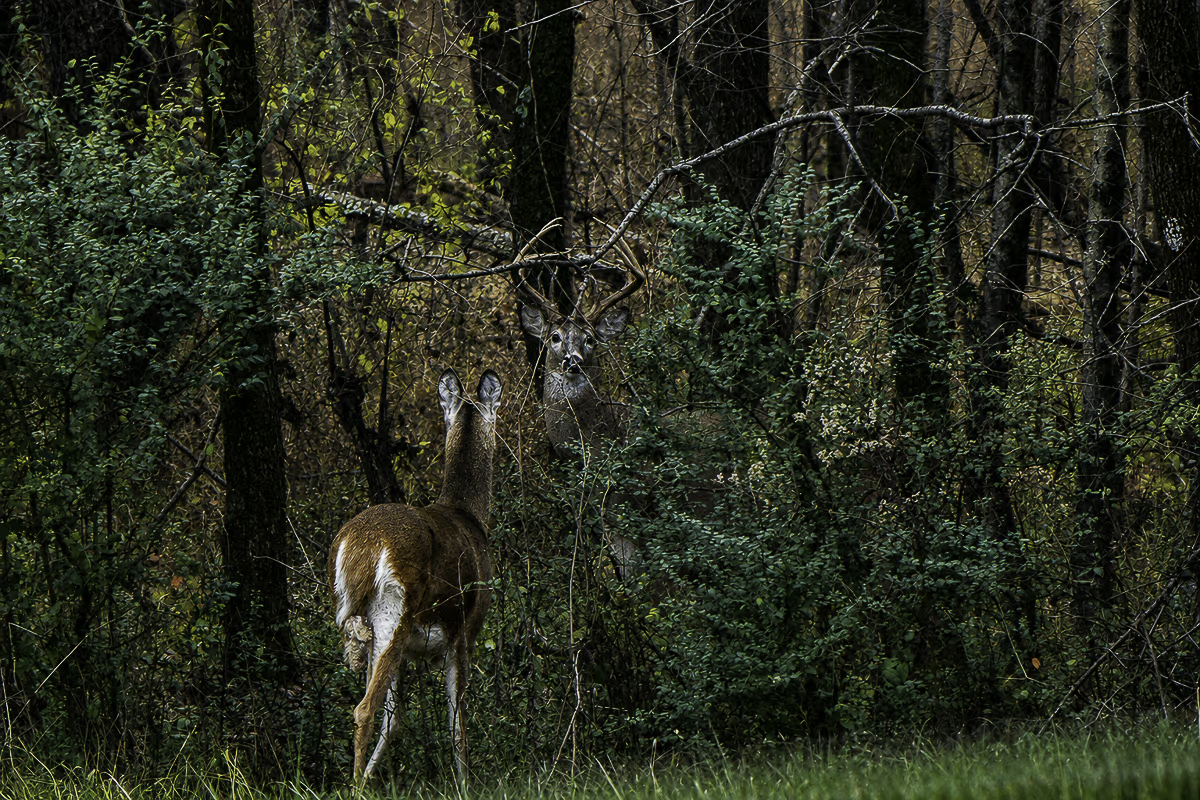
It was the morning of November 2, 2023 and I was running late to a piece of public ground on the Kentucky Tennessee border I’ve hunted for years. I had the spot picked out the night before. Perfect setup for this time of year and I had high hopes for the morning hunt. As I pulled up to the gate, I caught the unfortunate sight of break lights. Someone had beat me to the punch. I pulled into the gate, and sat there for a minute, going through my options.
I decided to try a spot I’d looked at on the map a dozen but never hunted because it was close the road. Like many hunters, I’d convinced myself that to be successful on public land I needed to be as far off the road as possible.
That is one of the single most repeated pieces of advice give to those learning how to hunt whitetails, and it’s the reason I’d walked past one of the better setups on that property for years. Most public land deer hunting tactics you’ll read start from the same assumption. Get deep. Go farther than the other guy. Earn it with boot leather.
Here’s what I’ve come to believe instead. Distance from the road is a stand-in for the thing that actually matters, and it’s a bad one.
Hanging a Stand Where the Rule Said Not To
I was putting the last strap around the tree for my Lone Wolf when the sun started coming over the horizon. Later than I like to be getting settled in. Not late enough to matter, as it turned out.
The first hour was uneventful. That’s usually where a story like this ends on public ground. A guy sitting a spot he’s unsure of for the first hour, then walking back to the truck telling himself he’d wasted a morning and the spot was no good. I won’t lie to you. The thought had crossed my mind but I decided to stick it out because it was November and you never know what will happen.
Around 9 I started noticing deer filtering my direction. I grabbed my binos and picked out two bucks and a few does working toward me. One of those bucks was a definite shooter.
The smaller buck, a 130-class eight pointer, came down the trail past me at 20 yards with all but one of the does behind him. Out of sight in about a minute. If you’ve hunted long enough you know that feeling of watching a decent buck walk by while you’re waiting on a better one.
The bigger buck and that last doe never made it to the trail. They stopped in the timber and bedded down 70 yards from my tree.
Sit with that for a second. A mature buck, on public ground, on November 2, chose to bed inside 70 yards of a stand I could see the road from. He didn’t do it at midnight, either. He did it at 9 in the morning, on a piece of public ground that gets hammered.
He wasn’t avoiding the road. He was avoiding people, and nobody had been in there.
Where the “Get Away From the Road” Rule Came From
The rule isn’t made up. There’s real research behind it, and the numbers are convincing enough that I understand why hunters live by it.
Researchers with Penn State ran aerial surveys on a 114,000-acre chunk of Sproul State Forest during Pennsylvania’s firearms season. They found that 87 percent of hunters were sitting within a third of a mile of an access road, and that hunters were nearly three times less likely to hunt an area for every additional third of a mile out. Steep ground got skipped too. Every five degree increase in slope made a spot about 1.5 times less likely to see a whitetail hunter.
So yes. Most public land hunters stay close to their trucks, and the deep, steep stuff sees a fraction of the traffic. That part is true and I’m not going to argue with a GPS study.
But look at what that number actually says. Eighty seven percent of hunters were within a third of a mile of a road. It doesn’t say they were spread evenly across that third of a mile. And this is where the advice gets sloppy, because “close to the road” and “where hunters go” are not the same piece of ground.
In an article written by Josh Honeycutt for the National Deer Association, he discusses hunter behavior data on public ground. The article discusses how hunters almost never sit right along the roadways, and almost never hike more than three quarters of a mile to a mile from the truck. The bulk of them end up somewhere between 200 and 800 yards from the truck. NDA’s recommendation was to work the two ends of that spectrum and leave the middle third alone, which means either hiking a mile or more back or hunting close to the parking lots and roads.
Read that again. The same body of research that tells you to get away from the road also says the ground right along the road goes mostly unhunted.
That’s not a contradiction. It’s the whole thing in a nutshell. Hunters skip the close stuff because it feels too easy to be good, then they walk 400 yards and pile up right on top of each other. My spot on November 2 wasn’t unpressured because it was far. It was unpressured because it was close enough that hunters like me talked themselves out of it.
Public Land Hunting Tactics That Read Pressure Instead of Distance
If you take one thing from this, make it this: quit measuring your setups in yards from the truck and start measuring them by how likely a mature buck is to encounter a hunter in that location.
Deer respond to pressure, not to asphalt. Mississippi State researchers tracked adult bucks in Oklahoma under heavy pressure, roughly one hunter for every 75 acres. Over a two week season, bucks reduced the distance they traveled and started working smaller areas harder.
Here’s how I look at it now. On any piece of public ground, ask three questions before you ask how far the walk is.
Where does everybody park, and where do they walk from there? Trails, logging roads, and old two tracks are hunter highways. Deer figure them out inside a week of the opener. The pressure isn’t a circle around the parking lot. It’s a set of fingers running out from it, and there is unhunted ground between the fingers.
What spots make other hunters think twice? This is the good stuff. Cover that’s too thick to walk quietly through, a slough you’d have to wade, a slope steep enough to make you sweat, a strip of timber so small it looks like it can’t hold a deer. Also, and this is the one I missed for years, ground that’s so close to the road it feels beneath you.
Where are the bedding areas that allow a deer get to bed and still see or smell trouble coming? That big buck bedded where he did for a reason. He had thick cover at his back and open timber in front of him, and he had five hours of nothing happening to prove he’d made the right call. Small cover next to a place hunters ignore beats big cover with a trail running through it every time.
Where the hunt went south
I don’t want to leave you thinking I outsmarted anybody that day. The spot did its job. My luck just ran out.
I sat there and watched those two deer bedded at 70 yards until 2 in the afternoon. Five hours. I had time to plan every version of what was about to happen, and I’d been through most of them twice.
At 2 the doe stood up and started down the same trail the other deer had taken that morning. The buck got up with her. I knew right then I was about to get my chance, so I grabbed my bow and got positioned in the tree.
About the time they were going to be in range, I felt that cool November breeze switch and hit me on the back of the neck. Both of them put the brakes on. Then I felt it again, and that one must have carried a heavy dose of me straight down to them, because they turned and trotted off the way they’d come.
That’s it. Five hours of the best sit I’ve had on public ground, and it went sour in fifteen seconds.
Could I have done something different? Honestly, it was just wind doing what wind does. I knew the wind was going to shift that afternoon and had plans to hunt a different spot. The tree I picked was perfect for the morning wind and I had no idea I would be pinned down until 2 in the afternoon.
How to Hunt the Spot Once You Find It
Say you find an overlooked spot on the public ground you hunt. Here are a few things to remember to increase your chances of success hunting public land.
Firstly, a short walk is not a reason to be careless. Use the same wind discipline (wind in your favor for both access and during the hunt) and slow pace you’d use to get to a spot two miles deep.
Secondly, pick two setups instead of one. If you get settled into your first tree and the wind shifts a couple hours in, you already have an alternative to keep the wind in your favor.
And thirdly, when your find a honey hole like this don’t tell anybody where it is. That does without saying, but I’ll say it anyway. You’d be surprised.
FAQ’s
Do deer avoid roads on public land?
They avoid people. Research on hunted does has shown them moving farther from roads where hunting pressure was concentrated, and the important words there are “where hunting pressure was concentrated.” Deer live next to roads year round. What changes in October is us.
What’s the best time to hunt public land deer?
Weekdays, if your schedule allows it. Most hunters are what most refer to as “weekend warriors”.
Is public land deer hunting worth it?
For me, yea. The honest answer is that it depends on what you want out of a season. You’ll eat some tag soup, you’ll get beat to spots, and you’ll deal with things you’d never deal with on a lease. If you’re on the fence, I’d start with the closest piece of public to your house and give it two seasons before you decide.
How do you find deer on a new piece of public land?
Start with an aerial and topo map to find the cover that’s hard to get to or easy to overlook, then check where the parking and trails are so you know where hunters will be. Walk it after season looking for deer sign, preferably buck sign, when you can’t hurt anything.
The Takeaway
I never killed that buck. What I walked out with instead was the answer to something I’d had wrong for a long time.
I’d spent years using a number to make my decisions for me. A third of a mile, a mile, whatever the number was that day, it let me skip the thinking. And the whole time the thing I should have been reading was where the other hunters were, because that’s the only thing on that property a deer was keeping track of.
Deer don’t care how far they are from roads. They care about human pressure.