

"We participate in affiliate programs and may earn a commission from products on this page" Learn More
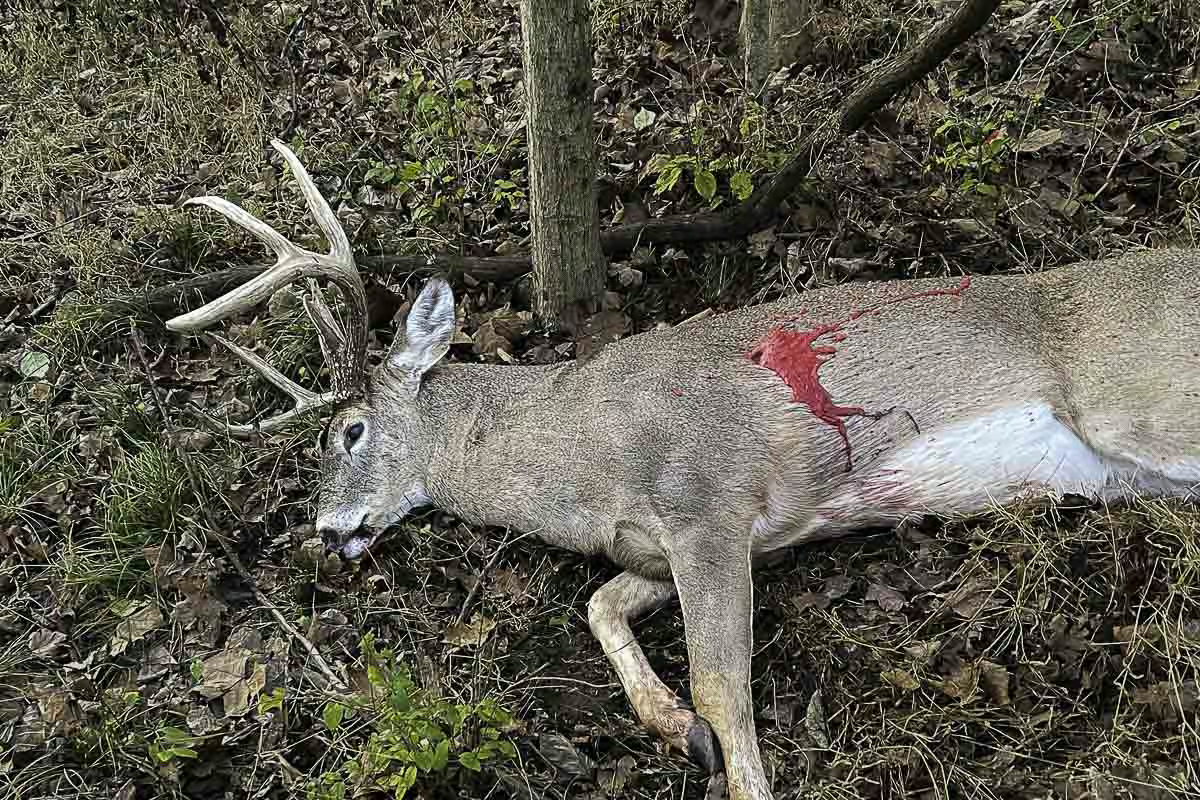
It’s December 15, 2023, 3:30pm and I’m I’m sitting in my Lone Wolf hunting the small block of timber next to my place of work. All week I’d had coworkers ask me if I’d seen the “big buck” that was frequently using the field next to the parking lot. I had not but I decided I’d give it a shot since I’ve hunted a handful of good deer there in years past. A little after 4, I saw him stand up from his bed, roughly 100 yards away, and start making his way down the trail in my direction. He stopped at 14 yards and my arrow and G5 Montec hit its mark going through both lungs. He made it no more than sixty yards.
That is the whole job of a broadhead, to punch two holes, leave a blood trail you can follow, and kill the animal as quickly as possible. The best broadheads for deer are the ones that do just that, not necessarily the ones with the biggest “cutting diameter” on the package. I shoot a G5 Montec. Here is why, and which four broadheads I’d buy if I didn’t.
Which broadheads are the best for deer?
The G5 Montec is my pick for deer, a one piece steel fixed blade that flies the same as my field points and can be sharpened instead of going in the trash after one use. The SEVR Titanium 2.0 is the mechanical I’d buy if I decided to switch back to a mechanical head.
Quick picks:
- Editor’s Pick: G5 Montec
- Best value fixed blade: Magnus Stinger Buzzcut
- Best fixed blade, money no object: Iron Will Wide
- Best mechanical broadhead for deer: SEVR Titanium 2.0
- Best value mechanical: Rage Hypodermic NC
I’ve hunted with one head on this list, the Montec, for the last four deer seasons. The other four are research picks from the makers’ own specs and reviews read online from sources I trust. I looked for steel that holds an edge, a cut that clears Kentucky’s minimum, and a track record longer than one product cycle.
Editor’s Pick: G5 Montec
The G5 Montec is a one piece stainless fixed blade with three cut on contact edges and nothing to assemble, replace, or lose. I hunt deer with it because it flies the same as my field points, produces good penetration, and can be sharpened on a flat stone if necessary.
Specs:
- 3 blades, one piece MIM stainless, cut on contact tip
- 100 grain cuts 1 1/16 inch, 125 grain cuts 1 1/8 inch
- .030 inch blade thickness
- 100 percent spin tested
Magnus Stinger Buzzcut: Best Value Fixed Blade Broadhead
The Magnus Stinger Buzzcut is a four blade cut on contact fixed head with a serrated main blade you resharpen or replace and a lifetime replacement guarantee. Buy it for the warranty and the bleeders, two more cutting edges for the price of a Montec.
I have not hunted with this head, so this is a research pick from Magnus’s specs and online reviews. Yes, a serrated edge looks like a gimmick, but Magnus has sold it for years and backs it like nobody else here.
The downside is the ferrule. It is aluminum, and aluminum bends on bone before steel does, and a free replacement does not help in November with one head left.
Specs:
- 4 blade, cut on contact, serrated chisel cut main blade
- 100 grain cuts 1 1/16 inch and runs 2 1/8 inches long
- 125 and 150 grain cut 1 1/8 inch
- Stainless blades, aluminum ferrule, lifetime replacement guarantee, made in the USA
Iron Will Wide: Fixed Blade Broadhead if Money Is No Object
The Iron Will Wide is a machined fixed blade with tool steel blades harder than anything else here and a main blade plus bleeder that cuts close to a mechanical’s hole. It is the fixed head for hunters who want that hole with no moving parts.
I have not hunted with this head, so this is a research pick from Iron Will’s specs. Yes, three of them cost what a hang on stand does, but they’re built to go through a deer, get sharpened, and do it again.
The downside is the price. Lose one in the beans on a pass through and you’ll spend the evening looking for an arrow.
Skip it if you toss heads after one deer.
Specs:
- .062 inch A2 tool steel blades, 60 HRC
- 2 1/8 inch total cut: 1 3/8 inch main blade, 3/4 inch bleeder
- 100 to 250 grain, double bevel standard, single bevel available
- Machined in the USA, ships in a travel case
Verdict: Great fixed blade broadhead but the hardest one to justify.
SEVR Titanium 2.0: Best Mechanical Broadhead for Deer
The SEVR Titanium 2.0 is a rear deploying two blade mechanical with a titanium ferrule, blades that lock open and pivot around bone, and a practice lock so you shoot the actual head. It is the mechanical I’d buy for the biggest hole here.
This is a research pick from SEVR’s specs and review written by Daniel Schmidt for Deer and Deer Hunting, not a head I’ve hunted with. Yes, it’s a pricey broadhead. The practice lock fixes the oldest mechanical problem: not knowing where your hunting head hits.
The downside is a rubber O ring. It holds the blades closed, it wears, and you replace it every time the blades open.
Skip it under 50 pounds of draw or with a light arrow, since every mechanical spends arrow energy opening.
Specs:
- 2 blade, rear deploy, 2.0 inch cut
- .032 inch 420 stainless blades, Grade 5 titanium ferrule
- 100 and 125 grain, standard 8-32 thread
- Practice Lock set screw included
- Sold individually, direct from SEVR only, limited lifetime warranty
Verdict: the mechanical to buy once your bow is tuned and you want a large entrance and exit hole.
Rage Hypodermic NC: Best Value Mechanical Broadhead
The Rage Hypodermic NC is a front deploying two blade mechanical with a needle ferrule and no collar or O ring to lose. It cuts the same hole as the SEVR for less money, and is on the shelf at most archery shops and sporting goods stores.
This is a research pick from Rage’s specs and reviews found online, not a head I’ve hunted with. Yes, Rage built its name on big entry holes and short blood trails, but if you shoot lower poundage or a light arrow expect less penetration than your typical fixed blade.
The biggest downside I found with this broadhead is the blades. Thin stainless bends and chips on bone so expect to swap out the blades or scrap the entire broadhead after one use on a whitetail.
Skip it on a low poundage bow or a traditional bow.
Specs:
- 2 blade, rear deploy, 2 inch cut
- .035 inch stainless blades, machined stainless ferrule
- 100 grain for vertical bows, 125 grain in the crossbow version
- Replacement blades sold separately
Verdict: the mechanical most hunters already shoot, for a reason, as long as you buy spare blades with it.
What should you look for in a broadhead for deer?
Four things decide whether a deer broadhead should make it to your quiver, in this order: it flies the same as your field points, it is shaving sharp, its steel and ferrule survive bone, and its cut clears your state’s minimum. Cutting diameter comes last, not first.
Flight that matches your field points
A fixed blade shows you every tuning problem your field points hide, and a mechanical hides them right back. Either way, shoot the hunting head into a target before the season. A group that moves means the bow needs work. If it’s not the bow, reevaluate the head.
An edge you can trust
Sharp is what kills. A dull broadhead pushes tissue instead of slicing it, and the blood trail shows it.
Steel and a ferrule that survive bone
Whitetail ribs bend thin blades and a shoulder bends aluminum ferrules. Look for stainless or tool steel blades and a steel or titanium ferrule. Blade thickness is on every spec sheet, and thicker survives bone.
What mistakes do hunters make buying broadheads for deer?
The biggest mistake is buying the head with the biggest cut instead of the one your bow shoots, then never shooting it before the season. Close behind: hunting a head straight out of the package, and blaming the head for a shot that never hit the vitals.
Are fixed blade or mechanical broadheads better for deer?
Fixed blades penetrate deeper, survive bone, and cost less per shot, and they’re the safer choice when shooting lighter poundage or from a traditional bow. Mechanicals forgive an untuned bow and cut a bigger hole. On a tuned compound over 50 pounds, both kill deer.